IT Asset Disposition
End-to-end retirement of laptops, desktops, servers, and networking equipment.
Certified data destruction, asset recovery, and compliant IT Asset Disposition for Mumbai enterprises that can't afford risk.

IT Asset Disposition (ITAD) is the documented retirement of end-of-life IT equipment — collecting it, destroying the data on it, recovering what still has value, and recycling the rest through an authorized channel, with a record at every handover.
PrivAce Technologies provides ITAD for enterprises in Mumbai, Navi Mumbai, Thane and Pune. We collect your retired IT free of charge, destroy the data on every media-bearing device before anything is recycled or resold, and issue a Certificate of Destruction for your compliance file. Processing runs through Green Life E Waste Recycling Pvt Ltd, our MPCB-authorized, ISO-certified partner.
These organisations have been served through Green Life E Waste Recycling Pvt Ltd, our MPCB-authorized, ISO-certified processing partner.

















Old devices still contain sensitive data, even after deletion or reformatting.
Improper disposal creates audit risk and regulatory exposure under the E-Waste Rules.
Unused assets sitting in storerooms still hold recoverable value that's quietly being lost.
Four services that run as one documented process — not four separate vendors and four separate paper trails.
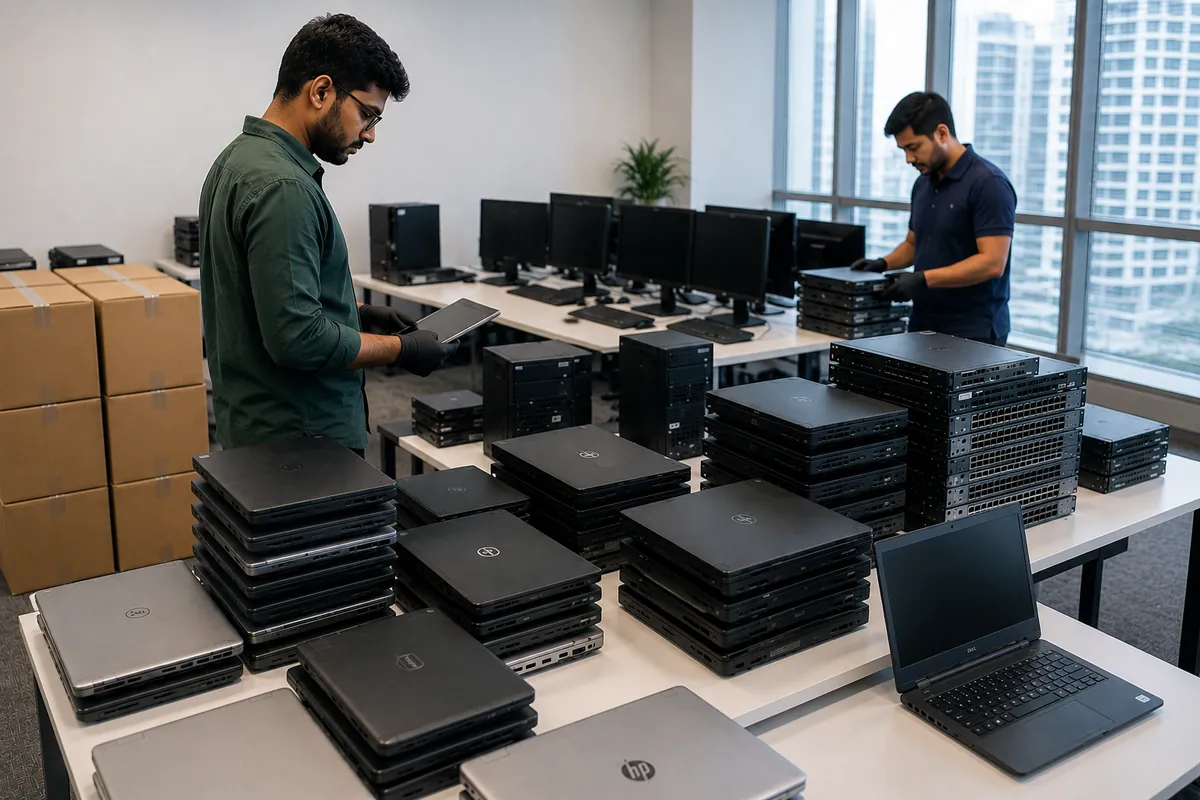
End-to-end retirement of laptops, desktops, servers, and networking equipment.
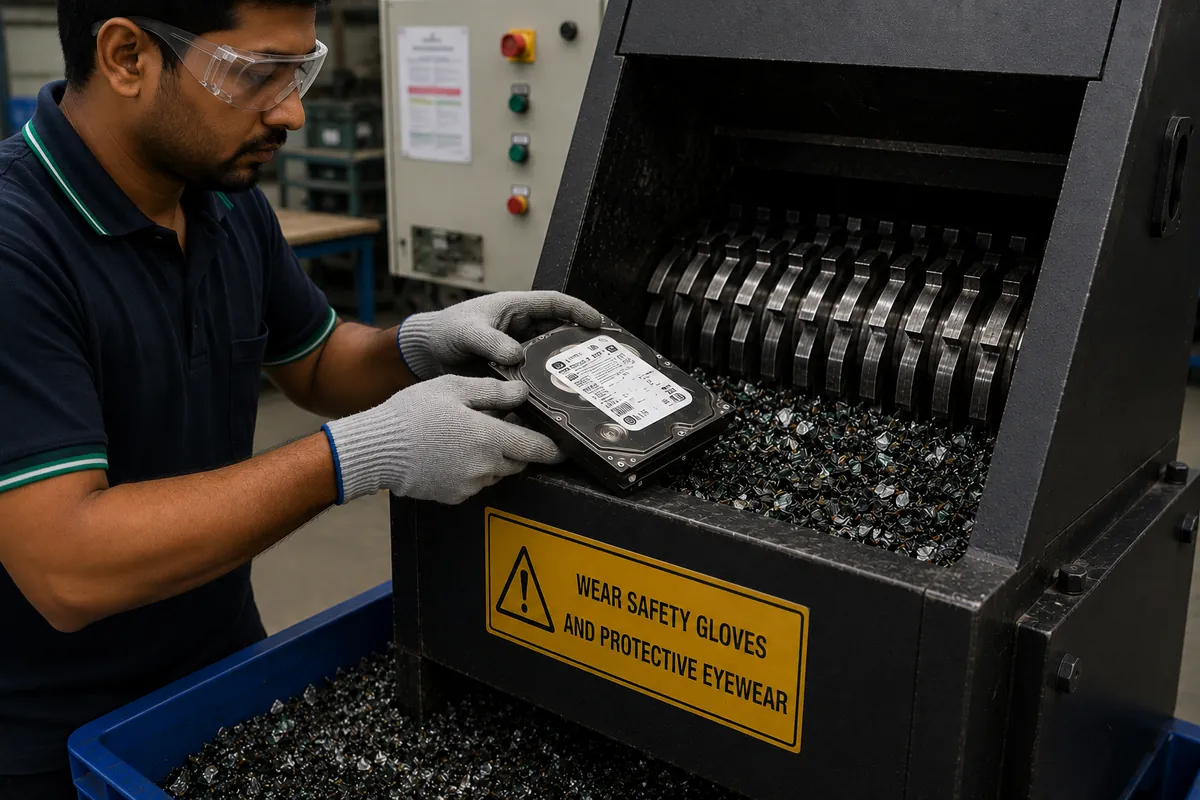
Software wiping and physical destruction, documented and certified per device.
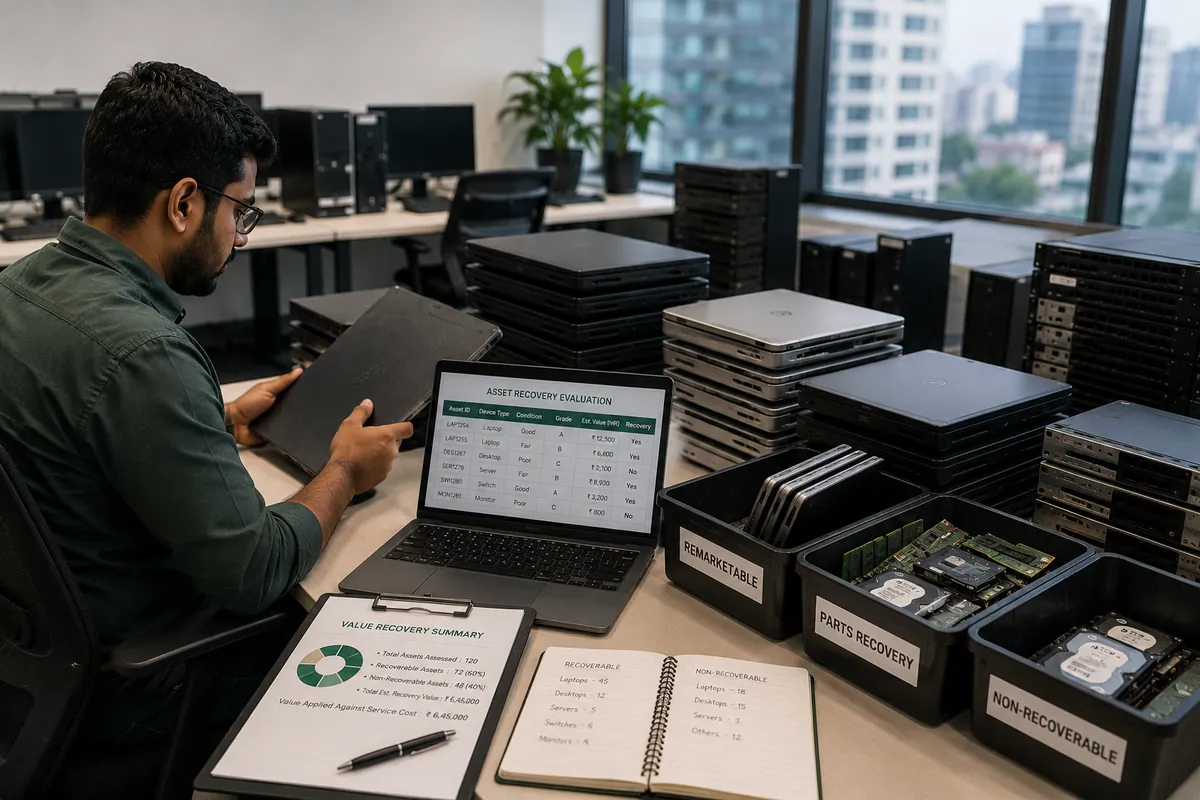
Maximising recoverable value from retired hardware before disposal.
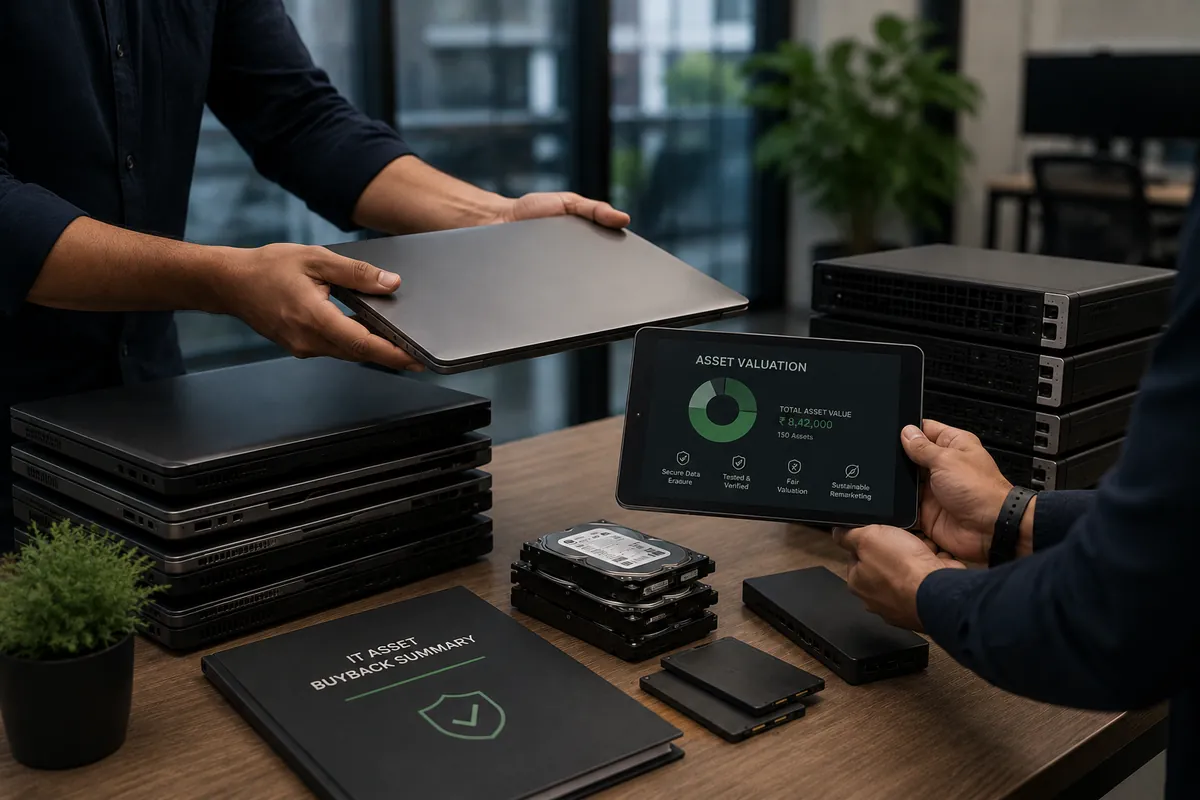
Structured buyback programmes for bulk device refresh cycles.
Every step documented, so the answer to “what happened to that device?” is a record, not a recollection.
Scope and timeline before anything moves.
Every device logged individually on site.
Chain-of-custody, premises to facility.
Certified wiping or physical destruction.
Serialised Certificate of Destruction.
Recovered value offsets your cost.
In that order — because that's the order your risk actually runs in.

Customer financial data on a retired laptop is a regulator's first question, not a hypothetical.

High device turnover, high call-data sensitivity — disposal has to keep pace with your refresh cycle.

Source code, client credentials, internal tools — the assets on your machines are your product.

Compliance-driven environments where audit trails aren't optional, they're expected.

Same data sensitivity as banking, same scrutiny, same need for certified proof.

Computer labs retiring in batches, student records at risk if not handled correctly.
Held by our MPCB-authorized, ISO-certified processing partner. Select any credential to see what it covers.
IT asset disposition is the process of retiring IT equipment in a way that leaves a record. It covers four things in sequence: collecting the equipment, destroying the data on media-bearing devices, recovering resale value where any exists, and recycling the remainder through a pollution-control-board-authorized facility. E-waste pickup covers only the last of those four. The difference that matters to a regulated business is documentation — who took the equipment, when, and where it went.
Ask for four things before you sign anything. One: the recycler’s current pollution-control-board authorization, with the expiry date and the categories it covers. Two: what documentation you receive at the point of collection, not weeks afterwards. Three: what happens to media-bearing devices, described specifically — software erasure, degaussing, physical shredding, or a combination. Four: what certificate you receive after processing, and at what level of detail. A vendor who cannot answer all four in writing is asking you to take the disposal on trust.
You can, and for a household it is fine. For a company it creates two exposures. The first is data: once the equipment leaves your premises without a wipe or destruction step, you have no way to establish what happened to the drives inside it. The second is the audit trail — under the E-Waste (Management) Rules, 2022, a bulk consumer is expected to channel end-of-life electronics to an authorized recycler and be able to show it. An informal sale produces cash and no evidence. The gap usually surfaces at the worst possible moment: during an ISO 27001 surveillance audit, a customer security review, or a regulator’s information request.
It means one of three physical outcomes, followed by a record. The storage media is overwritten using certified erasure software so the original data cannot be reconstructed; or it is degaussed, destroying the magnetic domains that hold the data; or it is physically shredded into fragments. Deleting files and reformatting a drive do none of these — both leave the underlying data recoverable with freely available tools. The international reference point for media sanitisation is NIST Special Publication 800-88, which separates the outcomes into Clear, Purge and Destroy. It is worth knowing that vocabulary when you compare what different vendors claim to do. See our hard drive destruction page for how each method applies to HDDs versus SSDs.
From a confirmed device list, pickup is usually scheduled within 24–48 hours across Mumbai, Navi Mumbai and Thane, and same-day is often possible on the Andheri–Saki Naka corridor where our office sits (Pranik Chambers, Saki Vihar Road). You receive documentation at handover. The Certificate of Destruction follows after processing, with timing depending on volume. Pune runs on a scheduled-route basis rather than same-week collection.
Yes. Servers, storage arrays, switches, racks and UPS units are collected and documented in the same way, though the drive counts involved are far higher — a single storage array can hold more data-bearing media than an entire floor of laptops. See server decommissioning.
Most companies are not choosing between two vendors. They are choosing between a transaction and a process.
| What you get | Informal scrap sale | Documented ITAD with PrivAce |
|---|---|---|
| Record of what left the building | Usually none | Documented handover and manifest |
| Where the equipment ends up | Untracked after handover | MPCB-authorized recycler, named on the paperwork |
| Data on media-bearing devices | Buyer’s discretion | Wiped, degaussed or physically destroyed first |
| Proof after processing | Nothing on file | Certificate of Destruction |
| Non-working equipment | Often refused or left behind | Collected on the same terms |
| Recoverable value | Immediate cash, unverified basis | Assessed after data destruction, offset against cost |
| What an auditor sees | A gap in the disposal control | A dated document trail |
This compares process, not operators. Plenty of authorized recyclers do careful work — the difference that matters is whether the disposal leaves a record you can produce twelve months later.
Running a scheduled refresh, decommissioning a floor, or clearing a storeroom that has been accumulating for years. You want one coordinated pickup, not four vendor calls.
Preparing for an ISO 27001 surveillance audit, a customer security review, or an internal control test where the IT asset disposal record is in scope.
You own the physical space and the vendor relationship. You need the equipment gone, the paperwork filed, and no surprise costs on the invoice.
Use a documented ITAD process when the equipment held company or customer data, when your organisation is subject to an information-security audit, when you are a bulk consumer under the E-Waste (Management) Rules, 2022, or when you are retiring five or more units at once.
You probably do not need us for a single household laptop, for equipment that never stored data and has no recoverable value, or where your organisation already has an authorized recycler under contract and is receiving proper documentation at every collection. In that last case the honest advice is to keep what is working.
Free enterprise pickup across the Mumbai Metropolitan Region, and scheduled collection in Pune.
Andheri East & West, Marol, MIDC, SEEPZ, Chakala, Chandivali. Our own corridor — often same-day.
ITAD in AndheriBandra Kurla Complex, Bandra East & West, Kalina, Kurla, Chembur. Built for BFSI compliance.
ITAD in BKCPowai, Hiranandani, Vikhroli, Kanjurmarg, Bhandup, Ghatkopar, Mulund.
ITAD in PowaiLower Parel, Worli, Parel, Dadar, Prabhadevi, Sewri, Byculla, Wadala.
ITAD in Lower ParelVashi, Turbhe, Mahape, Airoli, Ghansoli, Rabale, Belapur, Nerul, Kharghar, Taloja.
ITAD in Navi MumbaiThane West, Wagle Estate, Majiwada, Ghodbunder Road, Kolshet, Mulund, Bhandup.
ITAD in ThaneHinjewadi, Wakad, Baner, Balewadi, Kharadi, Viman Nagar, Magarpatta, Pimpri–Chinchwad.
ITAD in PuneBengaluru, Hyderabad, Chennai, Delhi NCR, Ahmedabad and beyond — assessed and scheduled.
Cities we serveThe regulatory and technical references behind the guidance above. We link the primary sources so you can check them rather than take our word for it.
Page last reviewed 30 August 2026 by PrivAce Technologies, Mumbai.
Free pickup across Mumbai, Navi Mumbai, Thane, and Pune. Most assessments scheduled within 24–48 hours.
 Talk to an expert
Free · 60 seconds · Score shown instantly
Ten questions, scored across Security, Compliance, and Sustainability. You see your score immediately — no email required to view it.
Call us directly — we’ll scope your IT asset disposal in minutes.
+91 973 973 2048Monday–Saturday · 10:00 AM – 6:00 PM IST
Try “data destruction”, “Bengaluru”, “certificate” or “EPR”.